Recap: Network Centrality and Clustering
DS701 Session 24 — Mon Nov 30, 2026
1. Centrality — “important” according to whom?
Every measure answers “which nodes matter?” — but each encodes a different notion of mattering:
- closeness — reach: I can get to everyone quickly.
- betweenness — brokerage: traffic has to pass through me.
- eigenvector — status: I am connected to the well-connected.
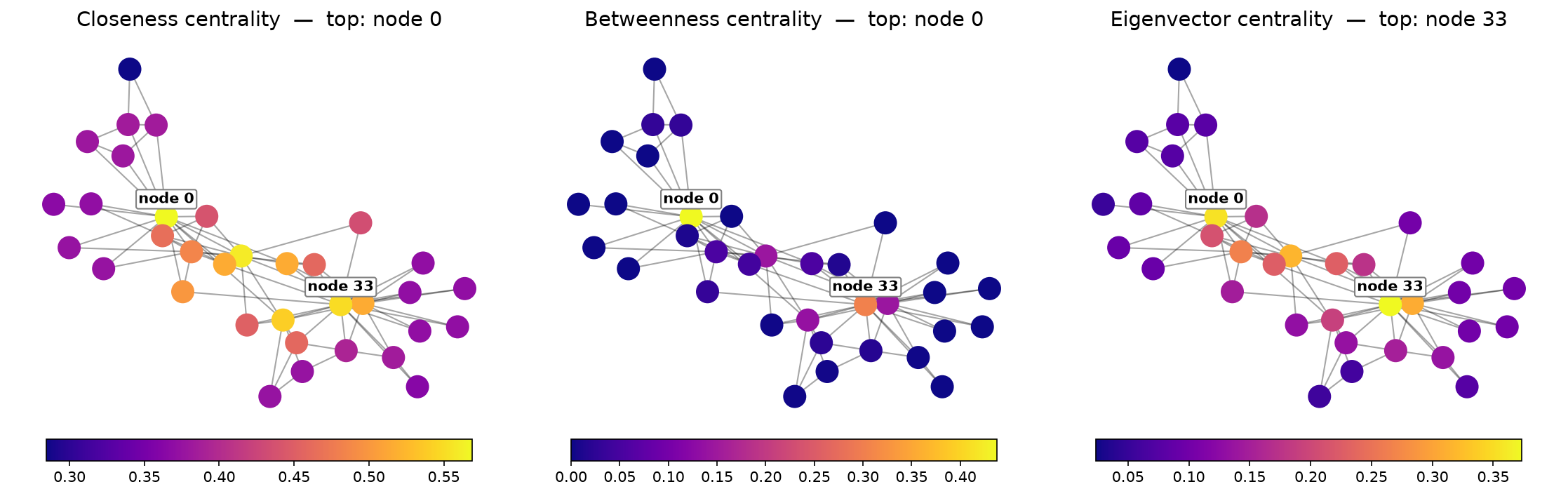
Same club, three colourings. The leaders (0, 33) top everything; the rest of the ranking is where the measures part ways — closeness is nearly flat, betweenness is zero for most and large for two or three brokers, eigenvector centrality lives inside the two dense factions.
4. Cuts: from “cheapest” to “balanced”

- Min \(s\)–\(t\) cut: fewest edges separating \(s\) from \(t\); polynomial. Zachary’s cut between 0 and 33 predicted the club’s split (all but node 8).
- Global min cut with no \(s,t\): peels off node 11 for one edge. Cheap, useless.
- Balanced cut: minimise \(\alpha = \dfrac{E(U, V\setminus U)}{\min(|U|, |V\setminus U|)}\) — edges removed per node disconnected. NP-hard → approximate spectrally.
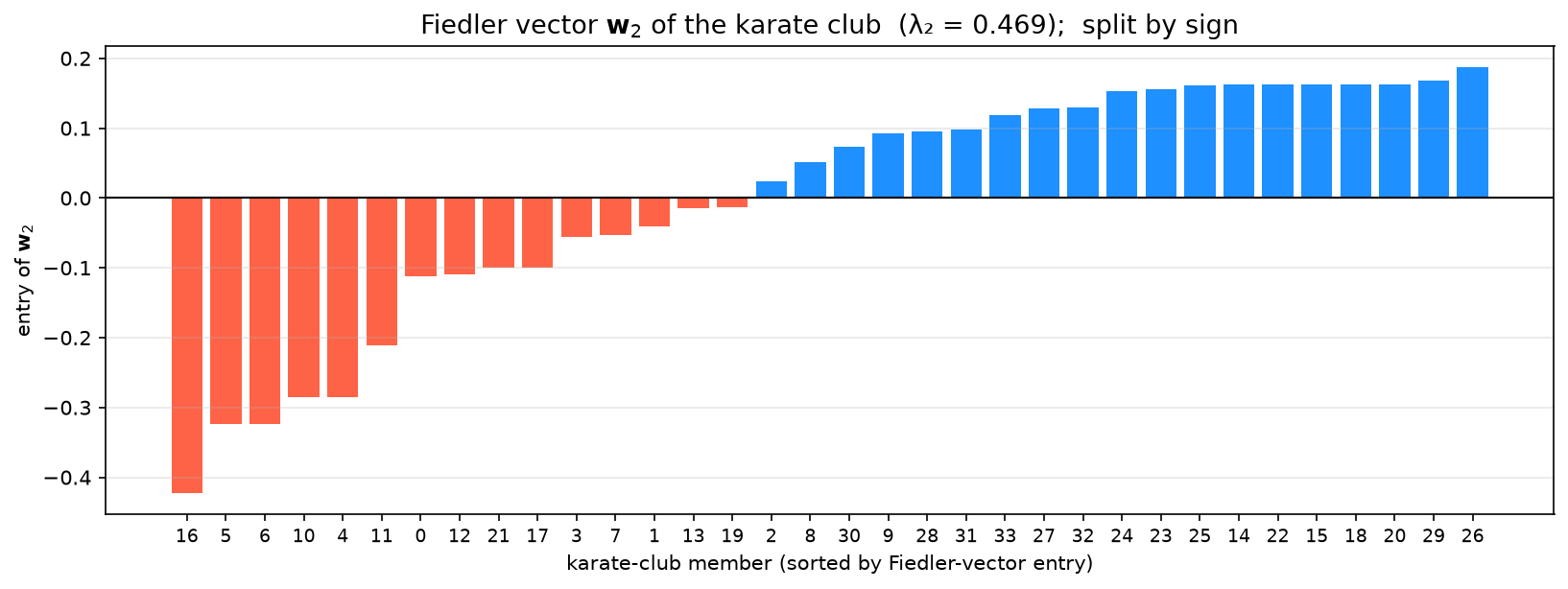
Right panel: the sign of the Fiedler vector on the unweighted karate club — 10 edges, sides 19 / 15, \(\alpha \approx 0.67\). (The lecture’s nx.fiedler_vector call used the edge weights NetworkX ships with the karate club, which moves nodes 2 and 9 across; the story is the same.)
5. The Laplacian, and why its second eigenvector cuts the graph
\[ L = D - A, \qquad \mathbf{x}^T L\mathbf{x} = \sum_{(i,j)\in E}(x_i - x_j)^2 \;\ge 0 \]
- Symmetric, PSD; \(L\mathbf{1} = \mathbf{0}\), so \(\lambda_1 = 0\) (only once if connected).
- \(\lambda_2 = \min_{\|\mathbf{x}\|=1,\ \mathbf{x}\perp\mathbf{1}} \mathbf{x}^T L \mathbf{x}\) — the Fiedler value; its eigenvector \(\mathbf{w}_2\) is the smoothest non-constant assignment of numbers to nodes.
- Smooth means neighbours get similar values → the two ends of \(\mathbf{w}_2\) are the two loosely-joined halves. Split by sign (or median, gap, best \(\alpha\)).
Activity: centralities by hand, PageRank from scratch, and a graph that disagrees
Goal: compute closeness, betweenness and eigenvector centrality on a real network (power iteration for the last), build PageRank with damping \(d = 0.85\) from scratch and check it against NetworkX, spectrally partition the same network with the Fiedler vector — then take a planted graph whose five centrality measures crown different nodes, tabulate and correlate the rankings, and match measures to questions.
- Work in groups of 2–3. Open your section’s notebook (A1: karate club, B1: Les Misérables).
- Parts marked (autograded) are submitted to Gradescope; the rest is participation.
- Staff will circulate — be ready to explain any part of your work.
- Dependencies:
numpy,pandas,matplotlib,networkx.
Section A1 

Section B1
The activity notebook goes live on the day of the lecture. Colab is optional — you can also open it on GitHub and run it locally.